.png)
.png)

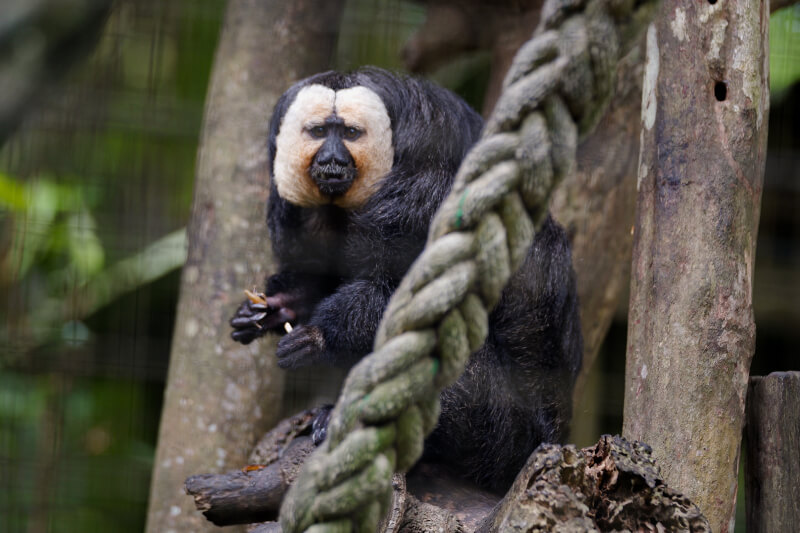
White-faced Saki
Pithecia pithecia


The white-faced Saki, a discreet primate of the canopy
The white-faced saki, also called white-faced saki (Pithecia pithecia), is a primate native to northern South America, including Guyana, Suriname, Venezuela and northern Brazil. It lives mainly in tropical rainforests, where it occupies the upper floors of the canopy. The species is now classified as Least Concern (LC) by the IUCN.
This monkey is distinguished by a very marked sexual dimorphism. The Male has a white face contrasting strongly with its dark coat, while the female has a more discreet, brown-gray coloring. This visual difference facilitates the recognition of individuals, including during their rapid movements in dense vegetation.
The white-faced Saki Is a primate Diurnal and strictly arboreal. It moves with agility in the trees, making precise jumps between branches, like other canopy monkeys like the Red-Faced Spider Monkey Or the Common squirrel monkey. It very rarely descends to the ground, preferring to stay away from forest cover.
Its diet is mainly frugivorous. It consumes fruits, seeds, nuts, and sometimes flowers or young leaves. Thanks to its powerful jaws, it can open hard-shelled fruits, an ability that is found in some forest primates such as the brown nasturtium. By feeding, saki actively participate in seed dispersal, thus contributing to the natural regeneration of the tropical forest.
At the Guadeloupe Zoo, the observation of the white-faced saki makes it possible to better understand the diversity of neotropical primates and the specific adaptations of species living in the canopy.














.svg)


Quelques anecdotes

A small family at the zoo
At the Guadeloupe Zoo, you can observe a group of pale-faced sakis composed of a couple, Karlos and Leaf. At the beginning of 2026, they welcomed a child: Pablo. An important and moving birth at the zoo. The baby stays attached to its mother's back hidden in her coat for the first few months of life.

A discreet observer
Very attentive to its environment, the saki spends long periods of time motionless, perched in the heights. This strategy allows him to spot unusual movements in the canopy, whether they are predators like the jaguar or other monkeys. When a hazard is detected, it emits brief vocalizations before rapidly moving to denser areas.
.svg)
