.png)
.png)

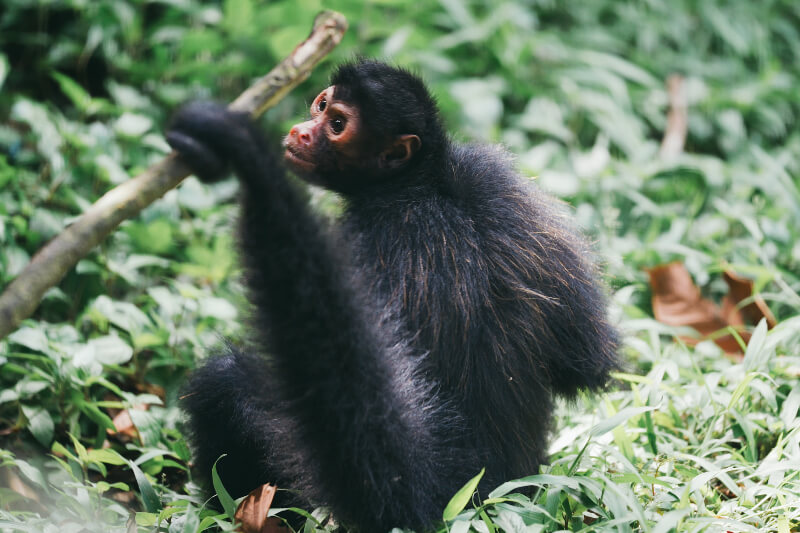
Red-Faced Spider Monkey
Ateles paniscus


Red-faced Spider Monkey
The red-faced spider monkey (Ateles paniscus), also called Kwata, is a large primate of South America. It lives in the canopy of primary forests, especially in Guyana, Brazil and Suriname. It rarely goes down to the ground and rarely occurs in secondary forest.
It is the most agile and fast monkey in South America. Its long arms and prehensile tail allow it to move from branch to branch without ever touching the ground. This tail, which also serves as a pendulum, acts like a real fifth limb.
The red-faced stele feeds mainly on ripe fruits, but also on leaves and seeds. By consuming these plants, it contributes to the dispersal of seeds, which is essential for the regeneration of the tropical forest.
The species is classified as Endangerd (EN) by the IUCN. It is threatened by deforestation and hunting, which considerably reduce its natural habitat.
At the Guadeloupe Zoo, the red-faced spider monkey participate in a European breeding and conservation program (EEP). Their presence makes it possible to raise public awareness about the protection of South American primates.













.svg)


Quelques anecdotes
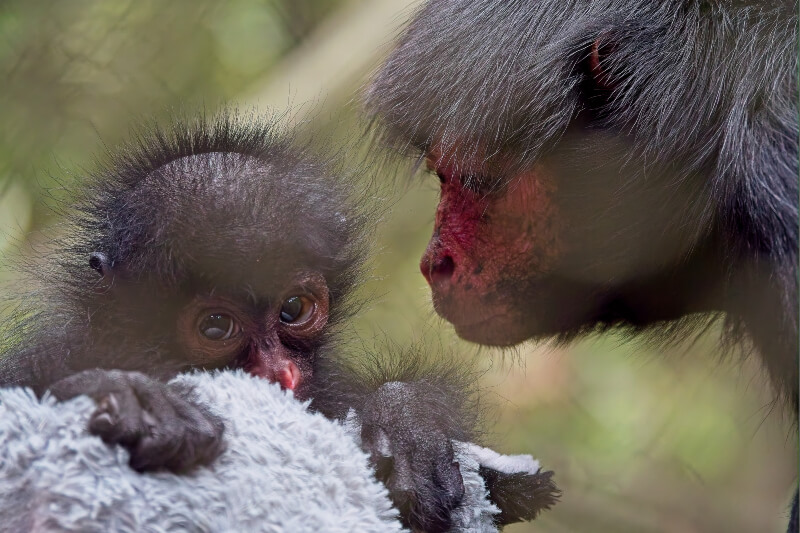
A nice adoption story: Caroline and Malya
In November 2024, a small baby named Malya was born at the Zoo. Unfortunately, her mother could not take care of her. Our team of caregivers fed and accompanied her for several months.
Every day, they put her in contact with the other members of the group, and more particularly with Caroline, our blue-eyed female harp. Caroline adopted her and now takes care of her as if she were her own daughter. A beautiful story of motherhood and solidarity between primates.
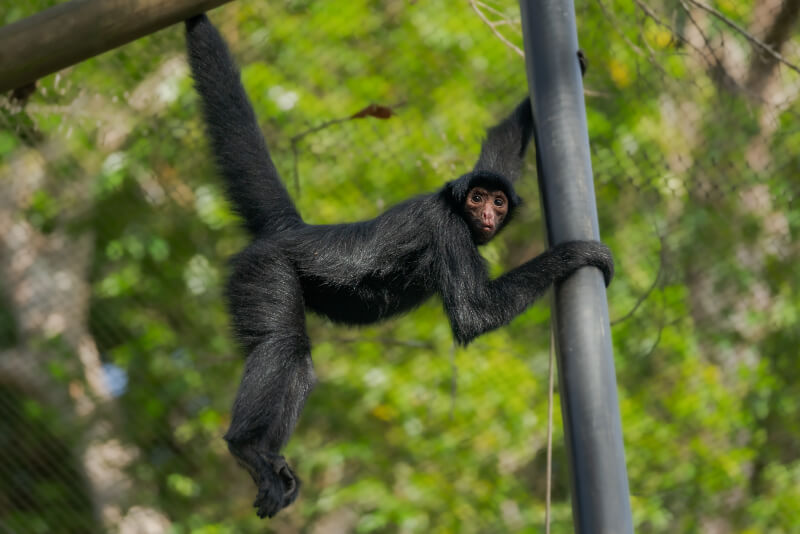
The “Marsupilami” of monkeys
The red-faced spider monkey is often compared to the Marsupilami for its incredible agility. Thanks to its prehensile tail, it can swing, grip and even hang with its strength alone.
During your visit, observe them in their enclosure: you will see these monkeys pounce and sway with spectacular lightness. A show of balance and grace that is unique among the Zoo's mammals
.svg)
