.png)
.png)


Macaw Hyacinth
Anodorhynchus hyacinthinus


The Hyacinth Macaw, the blue giant of the canopy
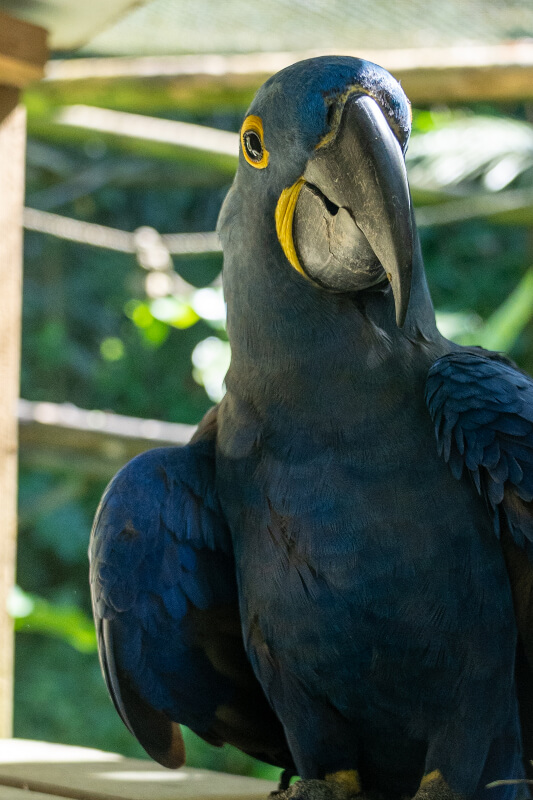
The hyacinth macaw (Anodorhynchus hyacinthinus) is the The biggest parrot in the world. Native to South America, it lives mainly in Brazil, Bolivia and Paraguay, in various environments: open forests, wooded areas, palm groves and regions close to waterways. The species is now classified Vulnerable (VU) on the IUCN Red List.
Impossible to confuse him. Its intense blue plumage, almost purple depending on the light, contrasts with the yellow areas around the eyes and at the base of the beak. Its large size, with a wingspan of more than one meter, makes it an instantly recognizable bird when it moves above the canopy.
The hyacinth macaw is a diurnal and arboreal bird. It spends the majority of its time in the trees, where it feeds, rests and interacts with its peers. Its beak is one of the most powerful in the bird world. It allows it to crack extremely hard nuts, especially those of certain palm trees, an ability that is found in other macaws such as Red-and-green Macaw Or the Great Green Macaw.
Its diet is mainly granivorous and frugivorous. It consumes nuts, seeds, fruits, and sometimes buds. By feeding, it participates in seed dispersal and plays an important role in the dynamics of forest ecosystems.
At the Guadeloupe Zoo, the hyacinth macaw makes it possible to address the conservation issues of large tropical parrots, in the same way as other emblematic bird species present in the park.




.svg)


Quelques anecdotes

Two new arrivals in 2025
In 2025, two hyacinth macaws joined the Guadeloupe Zoo. Josh, a male, and Takara, a female, form a pair closely observed by animal teams. Their arrival marks an important step in presenting and raising awareness about this endangered species, whose reproduction remains delicate in a controlled environment.

A specialist in tough nuts
The hyacinth macaw's beak is so powerful that it can break shells that few animals are able to open. This food specialization allows it to exploit very specific resources, where other birds have to give up. An impressive adaptation, which can also be seen in other large macaws in the park, each having developed their own techniques.
.svg)
